Resource Guarding Between Dogs: Complete Guide to Managing Multi-Dog Household Conflicts

Introduction
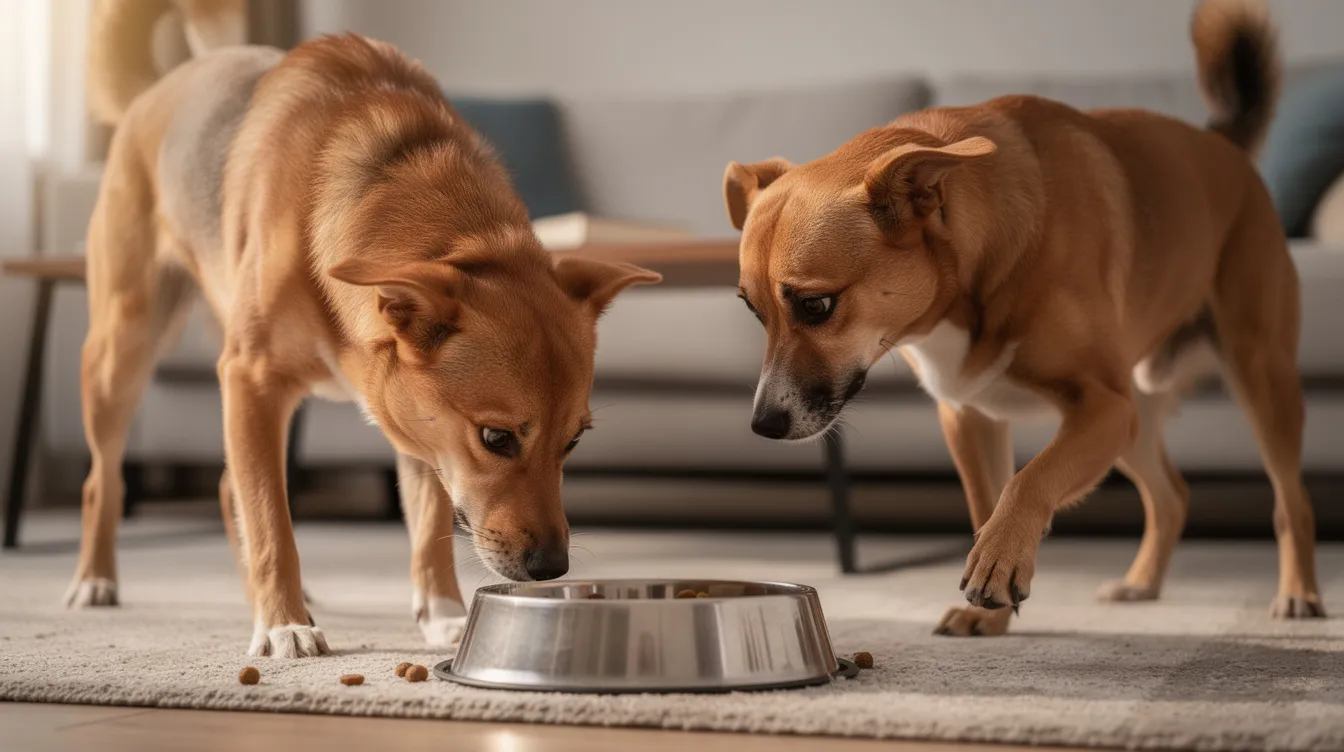
Resource guarding between dogs is one of the most common behavioral challenges in any multiple-dog household. It occurs when one dog protects valued resources-food, toys, beds, or even human attention-from other dogs through body language warnings, growling, or aggressive behavior. This guide addresses inter-dog resource guarding specifically, not situations where a dog guards items from humans.
If you share your home with two dogs, three dogs, or more, and you’ve noticed tension during mealtimes, standoffs over a favorite chew, or growling when one dog approaches another’s resting spot, this content is written for you. Resource guarding in dogs is a common behavior rooted in survival instinct, and while it’s considered normal behavior in the canine world, it can escalate into dangerous confrontations between beloved pets if left unaddressed.
The direct answer: Resource guarding between dogs involves one dog using behavioral signals-body stiffness, hard stares, growling, snapping, or biting-to control another dog’s access to something it values. It is linked to anxiety rather than dominance in dogs, and it responds well to structured management combined with positive reinforcement training.
Here’s what you’ll gain from this guide:
- How to identify the specific triggers causing resource guarding behavior in your household
- Practical management strategies you can implement today to reduce conflict and keep dogs safe
- A step-by-step counter-conditioning and desensitization training protocol for modifying resource guarding behavior
- Clear guidance on when to seek professional help from a trainer or board-certified veterinary behaviorist
- Prevention strategies to stop guarding from expanding to new resources or escalating to injury
Understanding Resource Guarding Between Dogs
Resource guarding is a dog’s behavioral strategy to protect valuable resources from perceived competition. In wild animals and free-ranging canids, defending food, territory, and shelter improved survival-those who could guard resources effectively were more likely to thrive. Even in comfortable domestic settings with plenty of food and toys, this deep-rooted instinct persists in many pet dogs. A dog guards because it perceives a threat to something it values, not because it’s trying to assert rank over the household.
This distinction matters. Traditional dominance models-the idea that a guarding dog is trying to be “alpha”-have been largely debunked by modern canine behavior science. Resource guarding often stems from anxiety in dogs, fear of losing something important, or past experiences where resources were scarce or unpredictable. Former street dogs may guard food due to past scarcity, and dogs with limited early socialization around other animals during resource access are particularly prone to developing guarding behavior. Misguided training, such as forcefully removing items from a dog’s mouth to “show who’s boss,” can actually create or intensify guarding behaviors. Understanding this psychology is essential because it shapes which interventions work-and which ones backfire.
Common Triggers in Multi-Dog Households
The most powerful triggers for resource guarding involve items dogs find highly desirable. Food bowls, tasty treats, rawhide resource chews, and high-value bones consistently top the list. A cross-sectional survey of over 3,500 dogs found that dogs in multi-dog households were significantly more likely to display guarding aggression, avoidance behavior, and rapid ingestion compared to dogs living alone. Common triggers for resource guarding include food, toys, and resting spots.
Beyond food, secondary resources drive considerable conflict. Stuffed toys-especially ones that squeak or are in limited supply-beds, and favorite sleeping spots all qualify. If your older dog has claimed a specific corner of the couch and a new dog wanders too close, that particular resource can spark a confrontation. Dogs may guard people in addition to physical items; when one dog receives affection, another may block access or wedge itself between the human and the other dog. Access to doorways, thresholds, and preferred locations like window seats can also become guarded territory.
The Psychology Behind Inter-Dog Guarding
Many guarding incidents are fear-based responses rather than true aggression. When a dog feels that another dog might take its food or toy, the dog’s emotional response is anxiety-an anticipation of loss. This fear manifests as freeze behavior, lip lifts, and warning growls, all designed to create distance without physical contact. Dogs often guard resources due to fear or anxiety, and only escalate to snapping or biting when these earlier warnings are ignored or when the perceived threat is too high.
Past experience plays a significant role. Resource guarding can occur in puppies as they learn their environment, but it also develops in adult dogs who’ve had negative experiences-harsh corrections during feeding, having valued resources yanked away, or competition in shelter or doggie daycare environments. Dogs with limited exposure to sharing space with other dogs around resources during their critical socialization period are more likely to develop defensive patterns.
A dog’s “stress bucket” can influence resource guarding behavior considerably. Stressors like a change in household routine, illness, the arrival of a new dog, or an unpredictable environment raise baseline arousal. Research shows that high impulsivity and fear are strong predictors of aggressive resource guarding. Neutered males showed higher odds of aggressive guarding in survey data, and adult dogs show more guarding than puppies, with seniors also at elevated risk. When stress accumulates, the threshold for triggering guarding behavior drops-a dog that normally tolerates another dog nearby during meals may suddenly snap when already anxious about other changes.
Recognizing Resource Guarding Signs Between Dogs
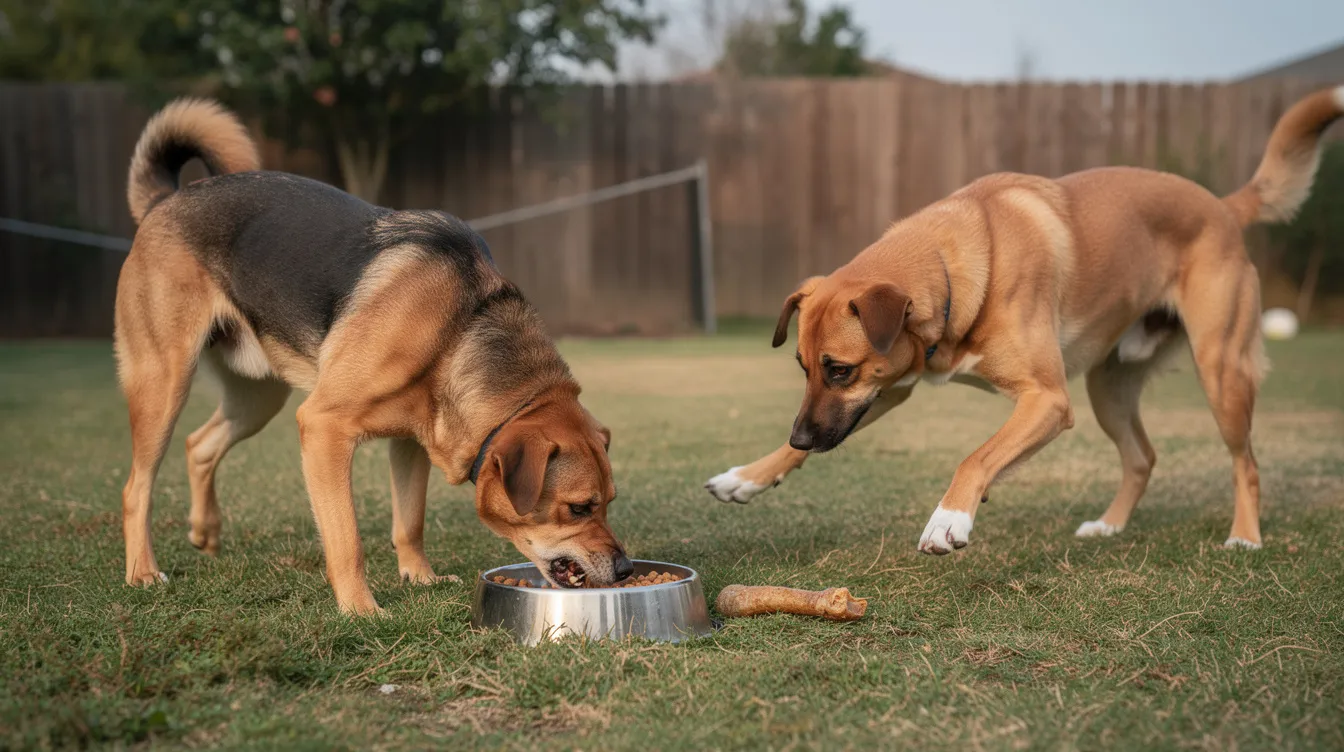
Recognizing early signs of resource guarding can prevent escalation of aggression. The difference between a manageable situation and a dangerous one often comes down to whether you can read the warning signs before they become full-blown confrontations. Resource guarding shows signs like growling, stiffening, or blocking access to items-and learning to spot the earliest versions of these signals gives you the window to intervene safely.
Subtle Warning Signals
The first indicators are easy to miss if you don’t know what to look for. Body stiffening is one of the earliest cues-a dog that was relaxed over its food bowl suddenly becomes rigid when another dog enters the same room. Hard, direct stares at the approaching dog, combined with positioning the body over the resource, signal that the dog is preparing to defend.
Other subtle signals include lip lifting without sound, low growling that may be barely audible, and eating noticeably faster when other dogs are nearby. You might notice a dog that normally eats at a leisurely pace suddenly inhaling its food when dog B walks past. Resource hoarding-carrying multiple toys to a single location or lying on top of items the dog isn’t actively using-is another early indicator. A dog growls as a communication tool, and these early warnings are actually useful because they allow you to manage the situation before it escalates. Punishing a dog for growling can escalate aggression and is not advised, because it removes the warning without addressing the underlying anxiety.
Escalation Indicators
If subtle warnings go unrecognized or are suppressed, behaviors intensify. Air snapping-biting at the air near the other dog without making contact-is a clear escalation. Lunging, blocking passage so the other dog can’t access a room or area, and persistent following of other dogs near resources indicate the guarder is no longer content with passive defense. Dogs might exhibit possessive aggression when another dog approaches something valuable.
Resource guarding can escalate from simple communication to aggression when the guarding dog feels its warnings aren’t working. Sustained aggressive episodes-where two dogs engage in repeated confrontation-carry serious injury risk. Escalation of guarding behavior can lead to fights between household pets, and at this stage, aggressive dog training with professional guidance becomes essential rather than optional.
Environmental Factors That Increase Guarding
The physical layout of your home matters more than many owners realize. Feeding locations with limited escape routes-such as a narrow hallway or a corner of the kitchen-create pressure because the non-guarding dog can’t easily retreat, and the guarding dog feels cornered with its resource. High-traffic areas where family members and dogs constantly pass by make resources in those zones more likely to be contested.
Providing ample resources helps reduce perceived scarcity. Multiple water bowls and resting areas can alleviate competition between dogs. When resources are abundant and distributed across different spaces, the motivation to guard any single item decreases. Times of increased household stress-visitors, home renovations, schedule changes-affect all dogs simultaneously, lowering everyone’s threshold and making guarding incidents more likely in the same room where they normally coexist peacefully.
Training and Management Strategies
Successfully addressing resource guarding between dogs requires combining immediate management with longer-term training. Management keeps everyone safe right now by restricting access to triggers, while training changes the dog’s emotional response over time so that the presence of other dogs near resources no longer feels threatening. Both pieces work together-management without training maintains the status quo indefinitely, and training without management creates dangerous rehearsal opportunities. Use management strategies to prevent resource guarding behavior while building a structured training plan.
Immediate Management Techniques
Management is your first line of defense and should begin the moment you recognize guarding behavior-even mild signs. These techniques don’t require training skills; they require consistency and environmental control.
Feed dogs separately. This is the single most impactful change for households where dogs guard food. Use crates, baby gates, or separate rooms to ensure each dog eats without visual contact with the others. Dogs should be completely separated during mealtimes and for at least 10–15 minutes afterward, until all food is consumed and bowls are removed. Management techniques for resource guarding include feeding dogs separately and removing high-value items.
Remove high-value items during unsupervised time. If your dog guards a rawhide resource or specific treasured toys, those items should only be available when you can actively supervise-or when dogs are in separate spaces. Removing treasured toys and high-value chews from shared areas eliminates the trigger during times you can’t intervene.
Create individual spaces. Each dog needs a place where it can retreat and feel safe-its own dog’s space. Use baby gates, exercise pens, or crate setups so every dog has a designated area. This is especially important in homes with many dogs where competition for preferred locations drives conflict.
Establish predictable feeding schedules. Inconsistent mealtimes increase anxiety around food availability. When dogs know exactly when meals arrive and that their portion is secure, the urgency to guard food diminishes. Consistent routines help each dog relax around mealtime rather than viewing it as a competitive event.
Counter-Conditioning Training Protocol
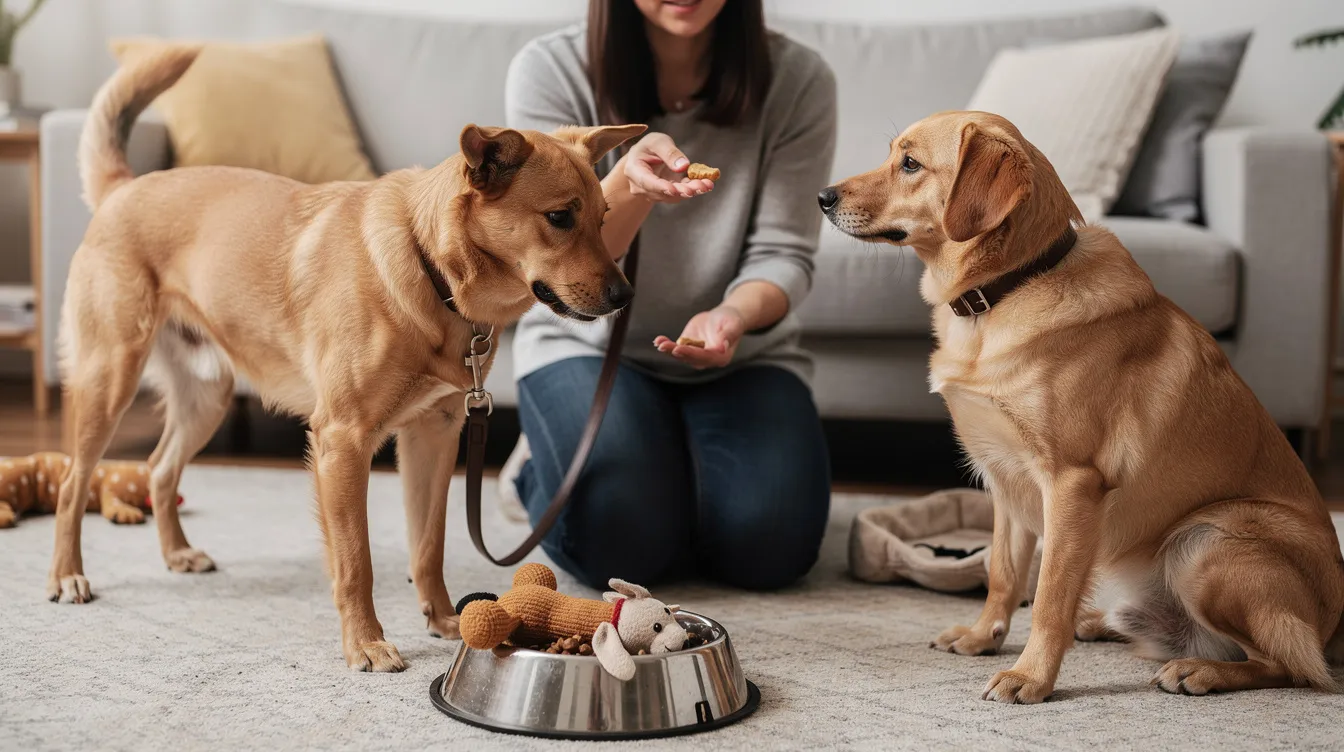
Counter-conditioning works by changing how a dog feels about a previously threatening situation. Instead of the dog’s guarding behavior escalating when another dog approaches, you systematically teach dog A that the presence of dog B near resources predicts good things. This protocol is most effective for mild to moderate guarding and should be implemented alongside management-never as a replacement. Practice positive reinforcement to change emotional responses throughout every step.
- Teach “leave it” and “drop it” commands to each dog individually. Before attempting any two training tasks simultaneously with both dogs present, each dog must reliably respond to impulse control cues on its own. Research shows that teaching “drop it” was linked with reduced likelihood of biting aggression. Teach dog A and dog B these cues in separate sessions using high-value rewards.
- Practice calm behavior around low-value items with significant distance. Place a low-value item (a toy neither dog cares much about) near the resource guarding dog. Position the other dog far enough away that the guarder shows zero signs of tension. Reward the guarder generously for remaining relaxed. The goal is to stay well under threshold-the distance at which the dog’s behavior remains calm.
- Gradually decrease distance while maintaining calm responses. Over multiple sessions (days or weeks, not minutes), slowly bring the approaching dog closer. Each increment should be small enough that the guarding dog shows no stiffening, staring, or change in body language. If any warning signs appear, increase distance immediately and work at the previous comfortable range.
- Introduce higher-value items as dogs show consistent progress. Once the guarder remains reliably calm with a low-value item and the other dog relatively nearby, begin the process again with a slightly more valued resource. Work through a “resource value ladder”-from least provocative items upward-only advancing when consistency is firmly established at each level.
- Practice in various locations where guarding previously occurred. Generalization doesn’t happen automatically. If guarding occurred near the food bowl area, near the couch, and in the doorway, you’ll need to practice in each location. Use “cold trials”-unstructured real-life moments-to test whether the dog’s new emotional responses hold outside of formal training sessions.
Teach dogs to feel relaxed when approached during guarding-this emotional shift is the core goal. Throughout, use trade games rather than forceful removal: offer something better in exchange for the guarded item. This prevents the dog from learning that the presence of another dog means losing its resource, which would intensify guarding rather than reduce it.
Professional Training Approaches Comparison
Choosing the right intervention depends on the severity of your situation, your capacity for daily structured work, and the risk level involved. Here’s how the primary approaches compare:
| Factor | DIY Management | Professional In-Home Training | Board and Train Program |
|---|---|---|---|
| Timeline | Ongoing; slow progress over months | Structured plan; visible progress in weeks | Intensive; faster initial behavior change |
| Cost | Low (supplies only) | Moderate (session fees) | Higher investment |
| Safety | Risk if owner misreads signals | Expert reads body language, sets safe thresholds | Controlled environment with continuous supervision |
| Best For | Mild guarding; confident owners | Moderate guarding; owners needing guided plans | Severe guarding; cases where dogs present a serious injury risk |
| Long-Term Success | Depends entirely on owner consistency | High with follow-through between sessions | Requires strong owner follow-up to maintain gains |
| Owner Involvement | Full responsibility | Guided with professional support | Intensive handoff training upon return |
For mild cases where one dog occasionally stiffens over a food bowl but responds to management, DIY approaches using other management strategies may be sufficient. For moderate guarding involving multiple resources, private dog training sessions provide the expert oversight needed to read body language accurately and adjust protocols safely. Professional trainers can help modify resource guarding behavior effectively, and positive reinforcement is essential in professional training for guarding.
For severe inter-dog guarding-where bites have occurred, where guarding is generalized across many resources, or where the household includes three dogs or more with complex dynamics- a board-and-train program offers the safest, most controlled environment for initial behavior modification. Resource guarding behavior can escalate without professional intervention, making expert guidance critical in high-risk situations.
Common Challenges and Solutions
Even with proper management and training, setbacks are normal. Modifying resource guarding behavior is not a linear process, and understanding common obstacles helps you respond effectively rather than losing progress.
Training Regression During Stress
A dog that seemed to have overcome guarding around its food bowl may revert during stressful periods-a household move, a new dog joining the family, illness, or even seasonal schedule changes. The solution is to immediately reinstate full management protocols: feed dogs separately, remove high-value items, and increase structure. During stressful transitions, maintain consistent routines, increase individual training sessions to rebuild confidence, and avoid introducing new high-value resources until stability returns. Think of regression not as failure but as information-the dog feels threatened again, and your job is to reduce that pressure. Redirecting unwanted behaviors during these periods requires patience and consistency.
One Dog Improving While Another Doesn’t
In homes with multiple dogs, it’s common for one dog to respond well to training while another continues to guard things due to deeper anxiety, higher impulsivity, or more entrenched fear patterns. The answer is individualized training plans. Work with each dog separately before controlled pair sessions. Ensure the improving dog isn’t inadvertently being put at risk by being exposed to the other dog’s unresolved guarding. Maintain strict management in all shared contexts and ensure equal access to resources-perceived unfairness can heighten tension. Sometimes an adult dog with extensive guarding history needs professional assessment that goes beyond what worked for its housemate.
Guarding Expanding to New Resources
Resource guarding frequently generalizes. A dog that initially only guards food may begin protecting toys, then beds, then the owner’s lap, then doorways. This expansion typically happens when early guarding goes unaddressed. Prevention starts with early intervention at the first sign of guarding over any particular resource. Map out your dog’s “resource value ladder” and begin counterconditioning work starting with the least provocative items. If you notice expansion occurring-your dog now guards other dogs’ belongings or dogs’ belongings it previously ignored-temporarily increase management (restricting access to new guarded items) and seek professional guidance to prevent undesirable behaviors from becoming entrenched patterns.
Multiple Dogs Ganging Up on One
When several dogs challenge a guarder simultaneously, or when one resource guarding dog faces pressure from multiple housemates, the dynamics become dangerous. In cases where dogs present this level of complexity, the risk of serious injury rises sharply. Management must include physical separation during all high-risk times-feeding, chew time, and access to preferred locations. High-value resources should only be given when dogs are completely separated. Seek professional help if resource guarding persists after training, and in multi-dog ganging scenarios, a veterinary behaviorist or experienced trainer should evaluate the household dynamics directly. Veterinarians can recommend qualified trainers for resource guarding issues suited to your specific situation.
Conclusion and Next Steps
Resource guarding between dogs is a manageable behavioral challenge-not a character flaw and not a reason to rehome a dog. With consistent management to prevent rehearsal of guarding behaviors and structured positive reinforcement training to shift how each dog feels about sharing space with other dogs near valued resources, most households see meaningful improvement. The key is recognizing that for many dogs, long-term management combined with training is the realistic and successful path forward. Fully eliminating every trace of guarding may not always be possible, but creating a safe, peaceful household absolutely is.
Start with these steps:
- Assess severity honestly. Is the guarding mild (stiffening, hard stares), moderate (growling, air snapping), or severe (bites, sustained fights)?
- Implement management immediately. Separate feeding, remove triggers during unsupervised time, create individual safe spaces using baby gates or crates.
- Begin basic training. Teach each dog “leave it” and “drop it” individually before any paired work. Use positive reinforcement training with treats to build a foundation of impulse control.
- Consider professional help for moderate to severe cases. A skilled trainer can read subtle body language, set safe thresholds, and create a customized training plan that accounts for each dog’s temperament and history.
If your dogs’ guarding involves bites, has escalated despite your efforts, or involves aggressive behavior around multiple contexts, professional intervention is the safest path. Understanding your dog’s behavior in the context of fear and anxiety-rather than outdated dominance frameworks-is what makes lasting change possible.
Additional Resources
Free Consultation: Off Leash K9 Training of Sterling offers behavior consultations and private training to evaluate your household’s specific guarding challenges and build a plan tailored to your dogs.
Safety Checklist for Multi-Dog Households:
- Feed all dogs in separate rooms or crates with doors/gates closed
- Remove high-value chews, bones, and treasured toys when dogs share space unsupervised
- Provide multiple water bowls in different locations
- Ensure every dog has its own resting area where it can stay calm without competition
- Supervise all interactions involving food, new toys, or novel items
Signs You Need Immediate Professional Help:
- Any bite that breaks skin between dogs
- Guarding that has expanded to three or more resource categories
- A dog that shows no warning signs before biting (suppressed communication)
- Guarding directed at both other dogs and humans
- Situations where you feel unsafe managing your dogs’ interactions
Resource guarding is a common behavior in dogs, but with the right approach, your dogs can learn to coexist peacefully around shared spaces and valued resources.
from Off Leash K9 Training of Sterling https://ift.tt/kpTUjdx
via IFTTT


Comments
Post a Comment